
August 2026 Newsletter
Dear HVTT Forum subscriber,
The main subject of this month’s newsletter is an update on the adoption of electric trucks in Africa, reported by Abdool Kamdar, HVTT Forum Board member and Technical Lead: Africa, Smart Freight Centre. I also report on my recent trip to Namibia regarding the PBS/High-Capacity Vehicle pilot project. And of course there is the regional weather update.
Electric trucks in Africa
Africa has been lagging other parts of the world in terms of road freight emissions accounting and reduction, as well as electrification. In response to this, the Smart Freight Centre’s training work in Africa has followed a deliberate progression in the past two years. It started with emissions accounting, getting operators to a point where they could measure CO2e emissions. That fed into road freight decarbonisation training for fleet managers, because measurement without operational levers to activate the reduction is not smart freight. Green freight procurement training closed the loop on the demand side, so shippers buying transport services could start asking for, and recognising, a lower-carbon offer. These three pillars are never separate; they’re one coherent intervention aimed at simultaneous emissions reduction and freight efficiency, because in this market one rarely gains support for one without the other.
In recent months that whole training stack has pivoted toward zero-emission road freight technology, electric trucks in particular, and the Northern Corridor (Kenya inland) has been the most active proving ground for that pivot at an inter-country level. That’s not a coincidence. The Northern Corridor is actively working toward a green transition.
The pivot towards electric trucks is poised to take off now because the underlying economics have shifted. Electric trucks are becoming more affordable at acquisition, and total cost of ownership calculations are starting to show a genuine business case, electric trucks costing meaningfully less per kilometre than diesel in the right duty cycle. That case is strongest on fast, high-utilisation corridor applications, which is exactly the segment around which some African trade corridors are built. This is no longer a subsidised-pilot story; it’s becoming a spreadsheet story, and spreadsheet stories are what move fleet procurement decisions. (A useful TCO calculator can be found at https://www.transportactiongroup.co.za/tco-v2 )
Whilst much attention is focused on the “chicken and egg” problem of charging infrastructure, the key barrier that remains isn’t cost. It’s mass and dimensions. African governments have not rolled out significant financial incentives for zero-emission trucks, and realistically most won’t in the short term. That means the policy lever available isn’t “add an incentive”, but rather “remove a disincentive.” Electric trucks carry more mass for the same payload because of battery weight, and where mass and dimension regulations are applied without adjustment, that penalty falls straight onto the truck’s economics and, just as importantly, onto the truck buyer’s perception of risk. It is important to understand why the “EV mass penalty” weighs so heavily on a transporter’s mind. A road freight company that achieves a 5% net profit, is considered acceptable performance; many companies operate below this profit margin. What it also means is that if the vehicle combination carries a 40-ton payload and if 2t of this is lost by going electric, it essentially means changing from a profitable to a breakeven business. This is what is top of mind when a transporter is asked to sacrifice payload.
A mass and dimensions honeymoon period (often referred to as a transitional mass and dimensions allowance), could take the form of allowance for, as an example, the first 5% of a country’s national truck park. This would be a meaningful, low-cost policy signal for first adopters. It doesn’t cost the fiscus anything, and it directly reduces the operational risk a first-mover fleet is taking on. There’s also a demand-side nuance worth mentioning: a large share of African freight trips run loaded in one direction only, and a significant proportion of that cargo is volume-constrained rather than mass-constrained. The actual share of loads that would reach the mass ceiling may be far less than the concession implies. But the psychological effect on a purchase decision, knowing the regulatory headroom is there, can be disproportionate to the real-world exposure.
It would be a positive policy signal if African mass and dimensions policies for early adopters could converge on something close to the European approach, and more importantly for a continent built on cross-border trade, that it be harmonised across countries. A truck that’s legally compliant in one country and non-compliant the moment it crosses a border isn’t a corridor solution; it’s a liability. Harmonisation is the difference between a national pilot and a corridor transition.
Training has resulted in operators measuring and buying differently. Technology and TCO are now doing the rest of the work. The remaining gap is regulatory and it’s inexpensive to close. It’s the kind of policy signal that costs governments nothing but changes what a first-mover fleet is willing to risk.
PBS/High-Capacity Pilot Project in Namibia
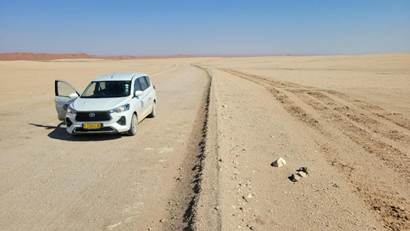
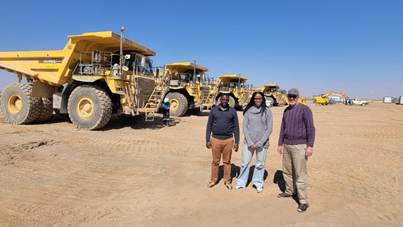
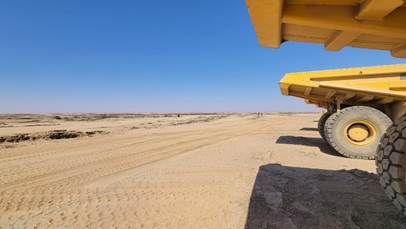
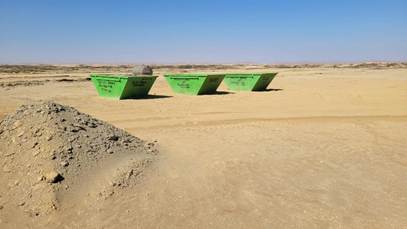
I recently spent a week in Namibia visiting all the current operators of PBS vehicles together with the Namibia Roads Authority. Commodities currently transported include bulk salt, grain, frozen fish, meat, grapes (seasonal) and mining ore; lead distances vary from 11 to 400km. Of particular interest was a visit to a green fields copper mine approximately 150km south east of Walvis Bay – see photos. The first blast took place a week before our visit. The transport operator will start using twelve 73.5 tonne (50 tonne payload) PBS 9-axle B-double side-tippers to transport approximately 4 200 tonnes of 6% copper ore per week to a concentration plant 20km from Swakopmund after which the concentrated ore will be exported via the Walvis Bay port. About 75% of the route consists of unpaved road. Tonnages and the number of PBS vehicles will increase as the mine scales up operations.
Weatherwise, we are well into spring and maximum temperatures in Pretoria are reaching close to 30°C. However, just 3 weeks ago, a widespread cold front resulted in significant snowfalls in many parts of the country. So, we are definitely into T-shirt weather, but brief cold snaps and isolated snowfalls are still possible into October.
All the best and drive safe,
Paul Nordengen
HVTT Forum Vice-President: Africa


