
June 2026 Newsletter
Dear HVTT Forum subscribers,
Greetings from Europe, where discussions on high-capacity vehicles continue to be considerably more dynamic than progress towards a harmonised European framework. With summer approaching, several interesting developments have emerged across the continent regarding high-capacity vehicles (HCV), illustrating once again that innovation often moves faster than regulation.
But before that, let me share some exciting updates on the preparations for our next HVTT Symposium, which will be once again held jointly with ICWIM, continuing the successful collaboration we enjoyed in Brisbane (2023) and Paris (2008). In 2027, the symposium will be hosted in the beautiful city of Ljubljana. Last month, we reached the first major milestone: the abstract submission deadline. I am delighted to report that we received a record number of high-quality abstracts from around the world, covering a wide range of symposium topics. The abstracts are currently under review, and authors will be notified of the results shortly. This response gives us good reason to believe that another great symposium lies ahead.
Now back to technical content…
Spain continues to move ahead with A-Double
Spain has quietly established itself as one of Europe’s most progressive countries regarding high-capacity vehicles while increasing the maximum permissible weight for A-doubles from 70 to 72 tonnes. Additionally, the network on which they may operate has been notably expanded as well. These regulatory changes have provided the confidence needed for transport operators to invest in the concept. The Spanish A-Double combination (see below) consists of two standard semi-trailers connected by a dolly and pulled by a 4×2 tractor unit. Because it uses rather standard equipment, it offers an easy entry point to high-capacity transport without requiring significant investment to special equipment. This differs from most other European applications, where 6×2 or 6×4 tractor units are typically used to ensure sufficient traction in local operational conditions.
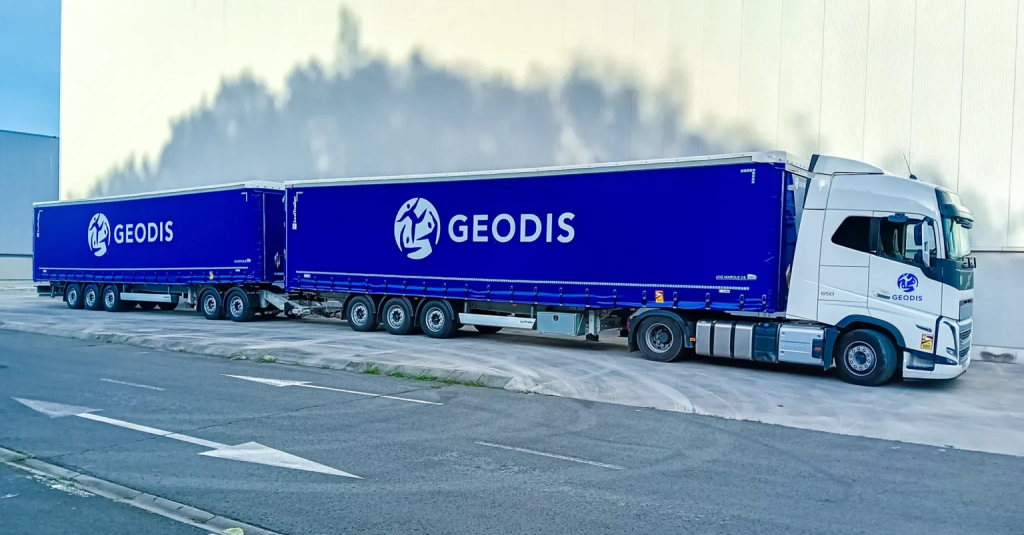
The Spanish example once again demonstrates that legislation can be a powerful enabler. Once the rules become clear and a suitable road network is available, industry investment follows quickly. It is perhaps no coincidence that Spain, which traditionally has not been considered a frontrunner in European HCV debate, is now moving faster than several countries that have discussed the subject for decades.
Expanding A-Double Networks in Scandinavia
Further north, Denmark introduced a trial scheme for A-Doubles already in January 2024, but the approved infrastructure network still covers only a few hundred kilometres (corridor Aarhus–Høje Taastrup–Øresundbrug). While enthusiasm for longer combinations is growing, identifying additional suitable corridors and obtaining the necessary approvals remains a challenge. This situation is familiar to many countries, where technical feasibility is generally less controversial than administrative implementation. This is preventing most operators from fully benefiting from the additional capacity and Danish transport association argues that the current regulations make the vehicles unnecessarily expensive and difficult to use.
By comparison, neighbouring Sweden—where trials started one month earlier—has already opened more than 6,000 km of roads for A-double combinations. However, it is important to note that Sweden allows alternative vehicle configurations that are easier to accommodate on existing infrastructure. A key difference is that Sweden permits vehicle combinations that require less space when cornering, making them more suitable for existing road networks. These vehicle types are currently not included in the Danish pilot scheme. Therefore, the Danish government is now considering adopting similar Swedish standards to expand the network and improve operational flexibility.
Belgium joins the Super Eco Combi club
Another noteworthy development comes from Belgium. Preparations are underway for the introduction of a Dutch Super Eco Combi (Dutch name for A-Double) in the port area of Ghent. The initiative, supported by logistics stakeholders and authorities in the port region, is expected to provide valuable operational experience under controlled conditions. Ports and industrial areas are often ideal environments for introducing longer combinations pilots because they combine high freight volumes with relatively limited interactions with urban traffic. In that respect, Ghent follows a path already explored by several Scandinavian ports.
The Belgian trial has also generated considerable interest in the Netherlands. Ironically, while Dutch-developed combinations are preparing to demonstrate their capabilities abroad, the official Dutch pilot programme for Super Eco Combis has not been progressing as planned. The necessary preparations have been ongoing for some time, however the start date of remains uncertain.
European harmonisation remains a dream
Despite the growing number of successful national initiatives, it is clear that a wide diversity of approaches still exists across Europe, making it challenging to establish a truly harmonized European framework. In addition, recent discussions surrounding the revision of the Weights and Dimensions Directive once again revealed strong opposition from parts of the rail transport sector, which continue to argue against broader deployment of high-capacity vehicles. This debate is hardly new. Supporters of high-capacity vehicles point to decades of evidence from Nordic countries and other regions showing improved efficiency, lower emissions, and means how to deal with increasing driver shortage, while critics continue to predict large-scale modal shifts and negative consequences for society. The result, once again, is that Europe risks replacing practical experience with prolonged political discussions.
Adding further colour to the debate, the International Union for Road-Rail Combined Transport (UIRR) recently published a joint statement on weights and dimensions based on citizen surveys. Long-time observers may experience a certain sense of déjà vu. If memory serves, similar exercises were conducted some fifteen years ago, but the resulting conclusions did not match real-world operations, according to many practitioners. So, it seems that some policy discussions, much like certain railway timetables, enjoy periodic repetition.
Let me conclude this month’s newsletter with a brief weather update from an overheated Europe, where five countries have set new all-time national temperature records over the past week. Although the Netherlands escaped this time, June has once again confirmed that weather forecasts should perhaps be interpreted as friendly suggestions rather than scientific predictions. Farmers complain about drought, holidaymakers complain about rain and thunderstorms, while the meteorologists carefully explain that both groups are correct. It appears that European weather, much like European transport policy, has become increasingly difficult to predict.
All the best,
Karel Kural
Vice President, Europe


