
May 2026 Newsletter
Hi everyone,
Greetings from Down Under!
In the essential and traditional weather update: I can sadly report that winter has officially started here in the Southern Hemisphere with temperatures dropping below 7 degrees during the nights in Brisbane and I had to dig out my jumpers!
The heavy vehicle industry in both Australia and New Zealand is going through some challenging times, but I think that is the same everywhere. Let’s start with New Zealand.
The primary production sector is the backbone of New Zealand’s economy, driven primarily by dairy, meat, wool, horticulture, forestry, and seafood. The dominating transport constraint in those areas is weight rather than cubic capacity. Industry has long pushed Transport Ministers to unlock productivity by allowing heavier loads, and saw the Government’s Fuel Response Plan consultation as another opening for those productivity benefits to be introduced. Unfortunately, the Minister has little appetite for that unless fuel supply worsens to the point of rationing, but the Ministry of Transport is investigating permanent VDAM (Vehicle Dimensions and Mass) changes alongside engineering assessments of the network; including around 4,700 state highway bridges and culverts.
The company that provides rail freight services has seen the pressures around fuel as an opportune time to advocate that rail is a better alternative to road because it offers better fuel intensity. Given the challenges around a shortfall in transport funding and an announcement by government on its Budget imminent, it will be interesting to see how government treat capital investment in road and rail.
On the regulatory side, recent legislative change gives NZTA stronger tools to regulate commercial operators which will help level the playing field and remove unsafe operators. And from 2029, driver education will be offered to secondary students. Students and young drivers are the transport industry’s workforce pipeline and with licensing rates trending down, the transport industry has long advocated for car driving education be included in schools. Providing young people the opportunity to study and prepare for a career in transport through driver training and licensing will help secure the future workforce.
In Australia, we have just finalised a landmark update to the PBS Directional Stability Under Braking standard, making advanced braking and stability technology a core part of the PBS safety framework. With the formal rule changes expected to come into force in early January 2027. The Heavy Vehicle National Law (HVNL) is undergoing its most significant overhaul in more than a decade, with Transport Ministers approving the final legislative package in May 2026 and the new law commencing in August. It brings major changes to the Mass, Dimension and Loading (MDL) rules, a mandatory Safety Management System (SMS), and a new Heavy Vehicle Accreditation (HVA) framework replacing the existing National Heavy Vehicle Accreditation Scheme (NHVAS); marking a fundamental shift in how compliance is structured, audited and enforced. The changes also include increases to General Mass Limits (GML) across most vehicle types, allowing operators to carry more freight within existing configurations. For instance, the Gross Combination Mass of a 26m long B-double will be increased from 62.5t to 65.0t. The allowable length for general access combinations has also been extended from 19 metres to 20 metres, providing greater flexibility for industry, while adjustments to towed mass ratio requirements for truck and tag trailer combinations offer more practical operating and safety settings for the load distribution on those vehicles. The updates also include changes to support the uptake of Euro 6 vehicles, increasing axle mass limits and mass transfer allowances to account for the additional weight of newer emissions technology. The NHVR has played an important role in shaping these changes; providing practical, evidence-based engineering advice throughout the process aimed at improving productivity while maintaining safe and efficient use of the road network.
At the NHVR, we are very proud to announce that the number of cumulative combinations participating in the Australian Performance Based Standards (PBS) scheme has surpassed 32,000 combinations, with May 2026 figures putting the grand total at 32,667 now participating in the PBS scheme since 2008! Reaching this despite mounting competitive pressure in the domestic freight market speaks to the perpetual relevance of PBS as a productivity and safety framework. Notably, for the second year on record, growth in PBS A-doubles outpaced that of rigid truck and dog combinations, indicating a deeper shift in fleet composition, and that industry recognises, and is willing to invest in, the operational, productivity and safety benefits delivered by PBS. Looking down the road, it is increasingly likely that PBS A-doubles will become the workhorse of the Australian heavy vehicle fleet. To this end NHVR has and continues to work with industry, stakeholders and the jurisdictions to open up access for safer more productive vehicles on the roads.
As it happens, 2026 gave that important work a sharper edge than any of us would have expected. In a positive sense, this year’s fuel squeeze presented a challenge the Australian transport industry has tackled head-on. The first months of 2026 saw global fuel supply severely disrupted as hundreds of service stations ran dry across the eastern states and Australia drew on its strategic fuel reserves for the first time since 2022. Government responded to assist and the NHVR worked to fast-track a host of mass and access arrangements, so operators could carry more per trip. But the deeper answer to a fuel-constrained world seeking to move more freight, is to move it smarter.
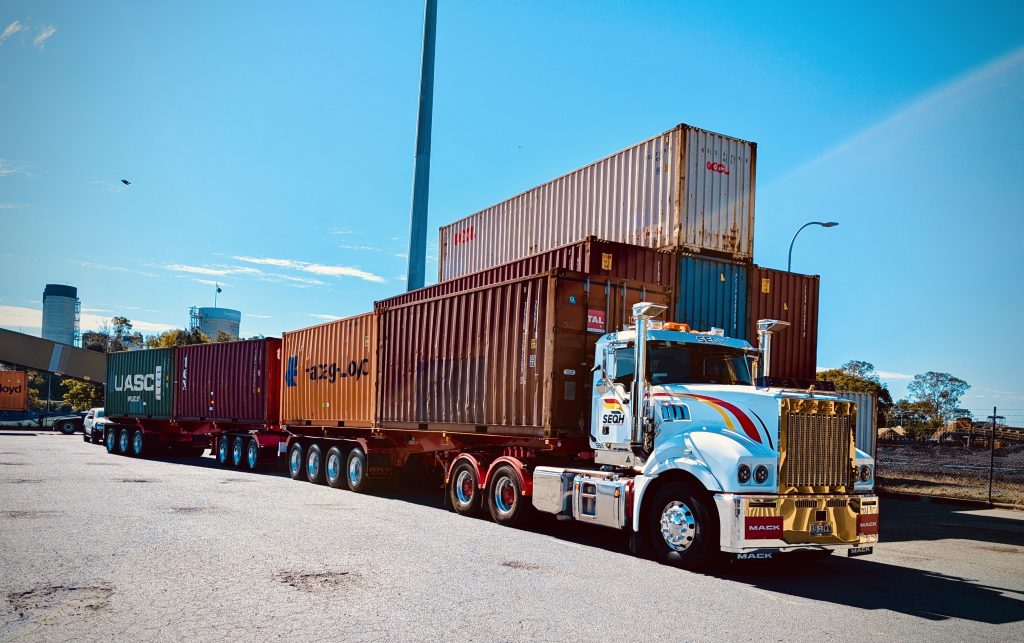
PBS has been proving that at a national scale for years, since it is the fountain of heavy vehicle innovation. But it must be said that necessity is the mother of invention, and PBS isn’t the only place it happens. Case in point – and I couldn’t resist including the photo of – the super A-double, a new innovative combination utilised in the port to carry heavy grain containers between depot and terminals. The combination Gross Combination Mass (GCM) is 143t, providing a productivity increase of 100% compared to even the PBS A-Double. This combination exceeds prescriptive mass limits and falls outside the PBS scheme, requiring a rigorous, evidence-based approach to ensure that productivity improvements are achieved without compromising safety or infrastructure integrity.
Best wishes, please drive safely!
Laszlo (Les) Bruzsa
HVTT Forum Vice President: Australasia and Pacific


