
January 2026 Newsletter
Dear HVTT Forum subscriber
I trust that you have experienced a good start to 2026, even though we are certainly living in uncertain times!
Besides an update on weather in the Region (which is significant I might add), there are two topics in this newsletter: progress with the introduction and rollout of electric trucks in Africa, input from Abdool Kamdar, an HVTT Board member, and the first phase of a project regarding the use of Weigh-in-Motion (WIM) equipment for overload control law enforcement in South Africa, input from Gerhard de Wet, an ISWIM Board member, and me.
Unlike many electric truck initiatives in Europe, Africa, with comparatively limited investments, seems to be quite far from the action. However, whilst the continent may not have access to major capital resources, it has not been idle. Key trade routes are stepping onto the global stage. The Northern Corridor joined the Global Green Corridors Initiative some time ago, and an electric truck demonstration drive from Nairobi to Addis Ababa during Africa E‑Mobility Week 2025 showed that long‑haul electric trucking is possible on African roads.
Much of the early electrification progress in Africa originated from buses. Countries such as Kenya, Rwanda and South Africa are rolling out electric bus fleets, which has directly led to local manufacturing and assembly. Companies such as BasiGo and BKG are clear examples of how strong policy direction and demand can translate into local industry, jobs and skills. That success matters for freight. As electric cars and buses scale up, the wider ecosystem improves. With early adoption, charging skills, grid planning, maintenance capability, and finance models all gain traction. This lowers the risk for freight operators. The Kuehne Climate Centre (KCC) and the Smart Freight Centre (SFC) have been at the epicentre of capacity building in East Africa through workshops on Carbon Accounting, fleet decarbonization, TCO (Total Cost of Ownership) modelling, and transition to electric truck planning. The challenge now is less about belief and more about choosing the right use cases: routes with strong total cost of ownership benefits and low ecosystem hurdles.
Policy choices also matter. While Europe continues to debate timelines for BEV targets, Ethiopia has taken a decisive path, banning imports of ICE passenger vehicles and, more recently, ICE trucks. The results are striking; there are now over 100,000 electric cars and 396 buses on the road, and a completed Green Corridor Transition Plan for the Addis to Djibouti corridor, setting the stage for electric trucks.
What comes next is action. In Kenya, the KCC and the SFC are working with the World Food Programme to launch an electric truck pilot project early this year. Africa may be moving quietly, but the direction is clear: electric freight is no longer a question of if, but where first, and how quickly the best business cases can be unlocked.
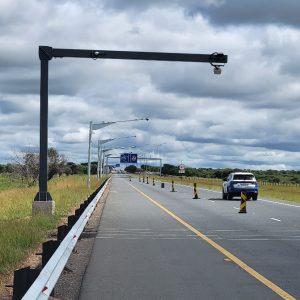
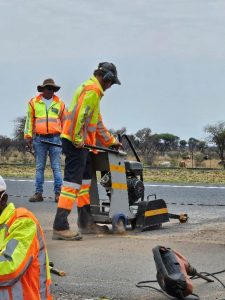
The South African National Roads Agency (SANRAL) recently initiated the first phase of the implementation of Direct WIM Enforcement, WIMe, in South Africa. This follows a two-year research project that was concluded in 2023. The evaluation phase of the project started in mid-2025 with WIMe technology trials to confirm that WIM systems can achieve the desired measurement accuracies for South African traffic and environmental conditions. The South African Legal Metrology Interim Requirement for WIM traffic law enforcement, which is largely based on OIML 134, was first published in 2024 and will be tested as part of the process. The NRCS (National Regulator for Compulsory Specifications) set the Maximum Permissible Error (MPE) for WIM for enforcement at:
- 5% for total vehicle/vehicle combination mass,
- 8% for axle unit/group loads and
- 10% for single axle loads (excluding drive and steer axles).
Ten WIM systems were approved for participation in the trial, representing a number of well-known WIM vendors. The accuracy of automated number plate recognition (ANPR) systems will also be tested as they are integral to the law enforcement process. The test site is located on the N1 national highway approximately 70 km north of Pretoria.
Construction of most of the installations is complete, and calibration of the systems will be completed in early Feb. Verification of the systems will commence in mid-Feb using four different test vehicles ranging from a rigid truck to a 7-axle B-double. It is anticipated that the trials will be completed by April 2026. The WIM technology trials will be followed by a phased rollout of a national WIMe network, which should ultimately consist of more than 170 WIMe systems nationwide.
|
|
Approximately ten days ago heavy rainfall and flooding was experienced in Mozambique and the eastern parts of South Africa and Zimbabwe. The Kruger National Park, which borders on Mozambique was hard hit. Many of the camps in the Park had to be evacuated at short notice and most of the Park entrances were closed due to overtopping of the access bridges. Much of the road network has been badly damaged and several bridge and culverts have been washed away. Many villages close to the Park were also badly affected, with many people having to be rescued from the rising flood waters. The floods were exacerbated by the continuation of heavy rain for almost a week. The floods were more severe than the last major floods in the area in 2000. On the other extreme, devastating fires fuelled by high temperatures and strong winds in the Southern Cape (Mossel Bay area) and around Franschhoek (La Motte wine estate in particular) have caused much destruction. In Pretoria, we have had a comparatively mild summer so far with good rains.
 Flooding and flood damage in the Kruger National Park |
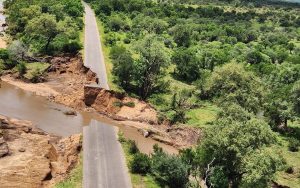 Flooding and flood damage in the Kruger National Park |
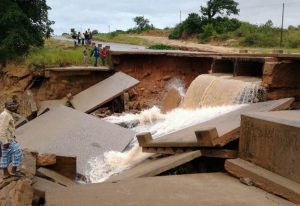 Flooding and flood damage in the Kruger National Park |
Best wishes for 2026 and drive safe.
Paul Nordengen
HVTT Vice-President: Africa


